Here in this article, we learned how to install Jupyter Notebook using Anaconda and Python pip command. Jupyter Notebook is one of the Best Python IDEs for data scientists and machine learning engineers. Although Jupyter Notebook installation could be challenging through Anaconda, it makes it easy to use other data science packages and programming languages. Today we will see how to install jupyter notebook to use python on a windows computer. Jupyter notebooks are electronic notebooks that can gather text, images, mathematical formulas and executable computer code.

They can be manipulated interactively in a web browser. Developed for the languages Julia, Python and R , it is now available for about forty programming languages. I hope this introductory guide to Jupyter notebooks provides you with the foundation. In this relatively a multi-part article, First, I started with the explanation of Jupyter notebook, its installation process, running locally on your workstation and so on. Next, during the process, you also got exposed to various components of Jupyter notebooks and keyboard shortcuts. After that, you learnt various magic commands in Jupyter notebook.

Finally, you learnt how to download and share Jupyter notebooks. I wrote an article before on how to install anaconda and jupyter notebook on windows. This article summarizes the method of installing jupyter on mac, not too simple. The exception is the special case where you run jupyter notebook from the same Python environment to which your kernel points; in that case the simple installation approach should work. It will always lead to problems in the long term, even if it seems to solve them in the short-term. For example, if pip install gives you a permission error, it likely means you're trying to install/update packages in a system python, such as /usr/bin/python.

Doing this can have bad consequences, as often the operating system itself depends on particular versions of packages within that Python installation. Once referred to as iPython Notebook, Jupyter Notebook is an open-source web application that allows users to interactively run code on a web browser alongside some visualizations. Now, let's understand how Jupyter environment works, I won't be going technical, though. As the Jupyter Notebook is a web application, it works on a server-client architecture. Once the notebook package is installed, type the jupyter notebook command on your terminal or command prompt to launch the Jupyter Notebook.

… Many Jupyter kernels have been created, supporting dozens of programming languages. The Jupyter Notebook can be used for data cleaning and transformation, data visualization, machine learning, statistical modeling and much more. This post will describe the step by step installation process of Jupyter notebook. In the previous article, anaconda has been installed, and jupyter notebook is installed on this basis 1. Install ipython After the installation is complete, enter ipython, as shown below, exit() exit ... The plotly Python library is sometimes referred to as "plotly.py" to differentiate it from the JavaScript library.
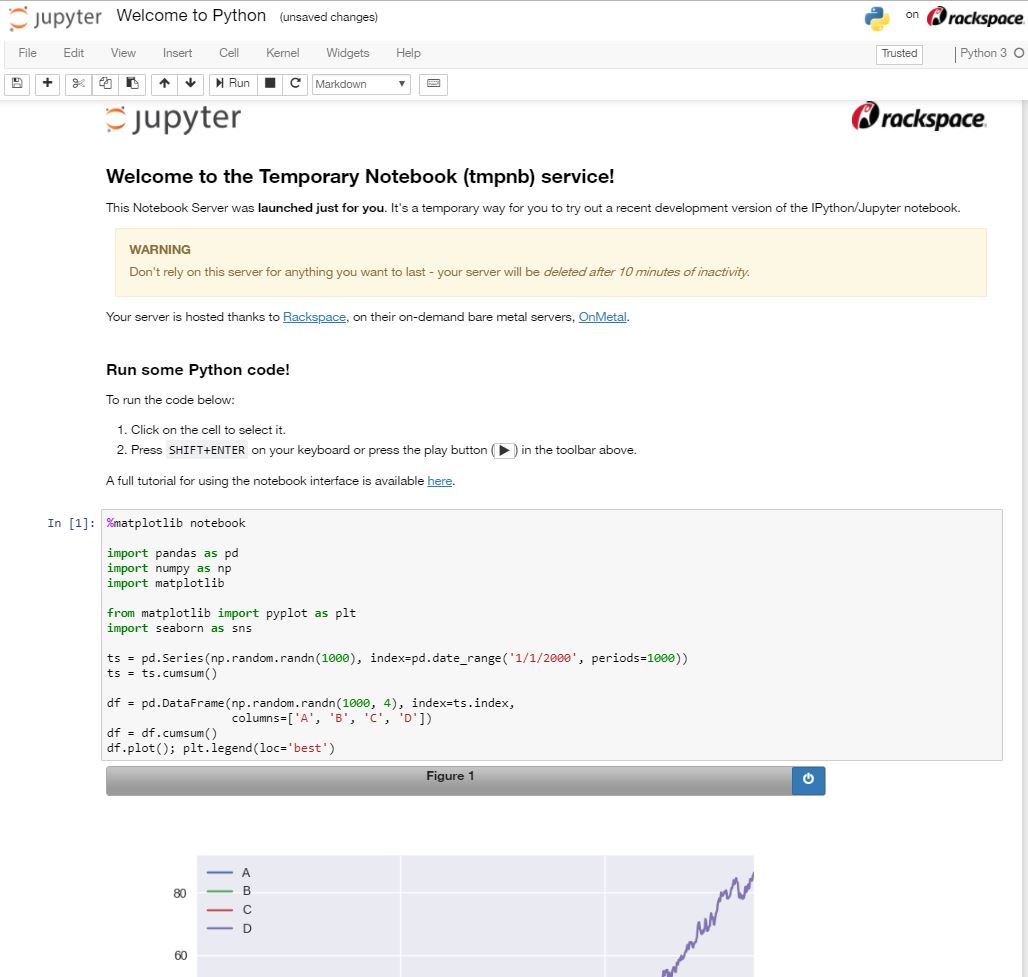
Jupyter Notebook is an open-source web application. This application allows you to create documents that can contain live code, equations, visualizations, images, and narrative text. This application is mainly used for data science or statistical evaluation purpose. So you can explain this application as a data science tool kit. Anaconda is great, but it consumes many resources and may lag on your system. The pip is the python package manager that comes with the most Python distributions.

And with a simple pip install command, Jupyter Notebook installs on your Python environment. First, the Python pip package needs to be installed. Then, the notebook extensions themselves need to be copied to the Jupyter data directory. That said, such a symmetry would certainly be a help to users. In this case pip install will install packages to a path inaccessible to the python executable. For this reason, it is safer to use python -m pip install, which explicitly specifies the desired Python version .

In addition to writing code with it, Jupyter Notebook is a productive and educative platform for tutors and learners to run data science or machine learning project chunks collaboratively. While in that virtual environment, run the pip install notebook command to install Jupyter Notebook. As with the Windows installation, you'll need a package manager so that you can install both Python 3 and Jupyter. Python 3 is required as the latest notebooks are not optimized for older python versions. Conda is an open-source, cross-platform package manager which comes pre-packaged with Anaconda's packages.

The conda package manager will provide you the command to install the Jupyter notebook for you. Once you have your python environment ready, you can use either the pip or the conda packet manager to install Jupyter on your machine. Other packages exist, but these are the most straightforward to use for new user installation. JupyterLab is a web-based, interactive development environment. It's most well known for offering a so-called notebook called Jupyter Notebook, but you can also use it to create and edit other files, like code, text files, and markdown files.

In addition, it allows you to open a Python terminal, as most IDEs do, to experiment and tinker. Terminal exactly works as it works on your local machines like Mac, Linux or cmd in windows. It is not limited to python language, but we can also write R, Julia, and JavaScript programs. It provides a feature of an interactive dashboard in Jupyter notebook. It means it also provides an option to add widget functionality. If we have taken a text widget, then text can be stored or can be used in the next cell.

The following image shows the steps in any data science project. Accessing data from the file system on your machine, data preprocessing, analysis to building machine learning models—you can do them all in Jupyter Notebook. Frequent question, can I install Jupyter notebook on Mac? For Mac users getting started with Jupyter, creating notebooks may seem complicated – but it's not. Let's test if python installed successfully, open command prompt and type "python". If python is installed correctly then you should able to see the python version number and some key help, as shown below in Fig 6.

The code type cells allow you to write live programming code. That is, you can perform any sort of programming in them. Once you run or execute a code cell, Jupyter notebook will present the output just below the cell. Running source /my/path/bin/activate activates the virtual environment. While the virtualenv is active, Python-related commands like python, pip, and jupyter will use to copies located inside the virtual environment.

You can check which copy of python you're using by running which python. Create a new Python project and install the jupyter package using the command pip install jupyter in the "Terminal" view. In particular under Linux is it discouraged to install pip packages alongside the packages managed by the package manager of the distribution (apt, dnf, pacman…).

Once Jupyter is installed, type the command below into the Anaconda Prompt to open the Jupyter notebook file browser and start using Jupyter notebooks. Jupyter notebook is a web application widely used by the developer community, which helps the developer write and share code documents. A Developer can easily access their code and data.
Use it to run, look at the instant output of the code cell and visualize the data. Notebooks are a very flexible, interactive, useful, and powerful tool in the hands of data scientists. If you're a beginner, it's recommended that you use the Anaconda distribution of Python.

In addition to Python, it comes with several useful data science packages pre-installed. The installation also includes Jupyter tools like Jupyter Notebook and JupyterLab. Anaconda is a Python and R distribution that comes with all the tools you need to start working with data, including packages, development environments, and more. Miniconda is a "minimal" version of Anaconda that requires less memory but does not come with any packages or environments pre-installed. Pip is the de facto tool for installing and managing Python packages. Pip searches for packages on the Python Package Index by default.
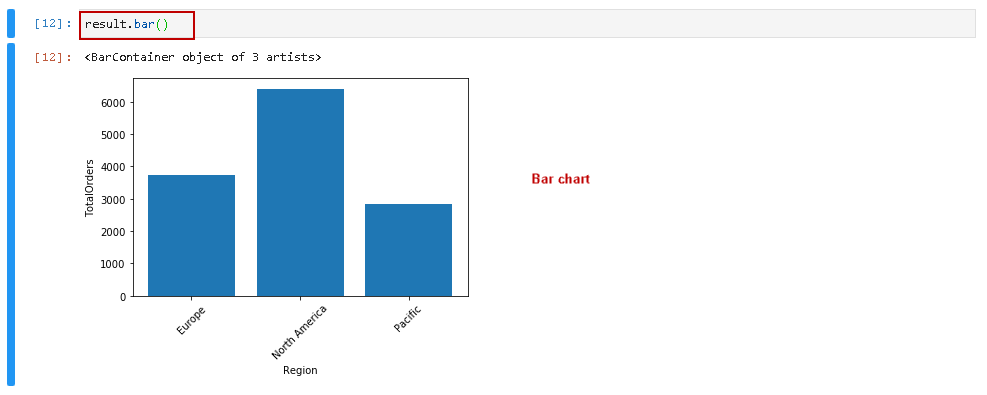
Unlike Conda, pip doesn't have built in environment support, and is not as thorough as Conda when it comes to packages with native/system library dependencies. Pip can be used to install packages in Conda environments. The Deep Learning AMI comes with many conda environments and many packages preinstalled.

Due to the number of packages preinstalled, finding a set of packages that are guaranteed to be compatible is difficult. You may see a warning "The environment is inconsistent, please check the package plan carefully". Despite this warning, SageMaker ensures that all the SageMaker provided environments are correct.

SageMaker cannot guarantee that any user installed packages will function correctly. Jupyter Notebook is an open-source web application that allows you to create and share documents that contain live code, equations, visualizations, and narrative text. Uses include data cleaning and transformation, numerical simulation, statistical modeling, data visualization, machine learning, and much more.

Once you do this, switching to the myenv kernel will automatically activate the myenv conda environment, which changes your $CONDA_PREFIX, $PATH and other system variables such that ! A similar approach could work for virtualenvs or other Python environments. For new users, we highly recommend installing Anaconda. Anaconda conveniently installs Python, the Jupyter Notebook, and other commonly used packages for scientific computing and data science. Once the requisite packages have been installed, you need to create a directory that will serve as the code directory. Inside this directory, you will create a virtual environment and later use it to install Jupyter Notebook.

Indentation of code -- Jupyter notebooks inherently perform indentation whenever required. However, if you want to change indentation manually, use Ctrl-] to indent the code in code type cells. In markdown cells, it will insert spaces according to the specifications of the tab key. When the notebook opens in your browser, you will see the Notebook Homepage as shown in the below snapshot. This will list the notebook files and subdirectories in the directory where the notebook server was started. Use the pip install notebook command to install Jupyter Notebook into that environment.

To use this method, you must have Python installed on your machine. Otherwise, head to the python.org website to download and install the latest version of Python. However, if you're a Mac or Linux user, you probably have Python already installed by default.

If you've configured separate kernel environments, install thersconnect-jupyter package in the notebook server environment as well as each kernel environment. If successful, PowerShell will echo with the python version printed on the terminal. If you see an error, either you do not have python installed, or python has not yet been added to the path. The simplest way to install Jupyter notebooks is to download and install the Anaconda distribution of Python.

The Anaconda distribution of Python comes with Jupyter notebook included and no further installation steps are necessary. So now that you have successfully downloaded and installed Jupyter Notebook for your Python environment, it's time to create your first notebook. In this section, we will walk you through how to create and save a notebook. We will also discuss some of the core terms of Jupyter Notebook and write some Python code. Anaconda is an open-source software that contains Jupyter, spyder, etc that are used for large data processing, data analytics, heavy scientific computing. Anaconda works for R and python programming language.

Spyder(sub-application of Anaconda) is used for python. Package versions are managed by the package management system called conda. Jupyter is a web-based interactive development tool that helps create the environment to share live codes, virtualizations, and interactive data.

As the name describes, it is a notebook that includes computer code and text. Whether you work as a Data Engineer or a Data Scientist, a Jupyter Notebook is a helpful tool. One of the projects I was working required a comparison of two parquet files.
This is mainly a schema comparison, not a data comparison. Though the two .parquet were created from two different sources, the outcome should be completely alike, schema wise. At the beginning I was manually comparing them then I thought there must be a tool to do that.

Well, that's how I found a Jupyter notebook can be useful to compare two .parquet files' schema. It is the markdown functionality that brings interactivity to Jupyter environment. Markdown cells not only lets you write text, but it allows you to format it, add a hyperlink, and include HTML code. Additionally, it also allows you to define ordered and unordered lists, insert images and tables, add mathematical equations, write in LaTex, and so on.
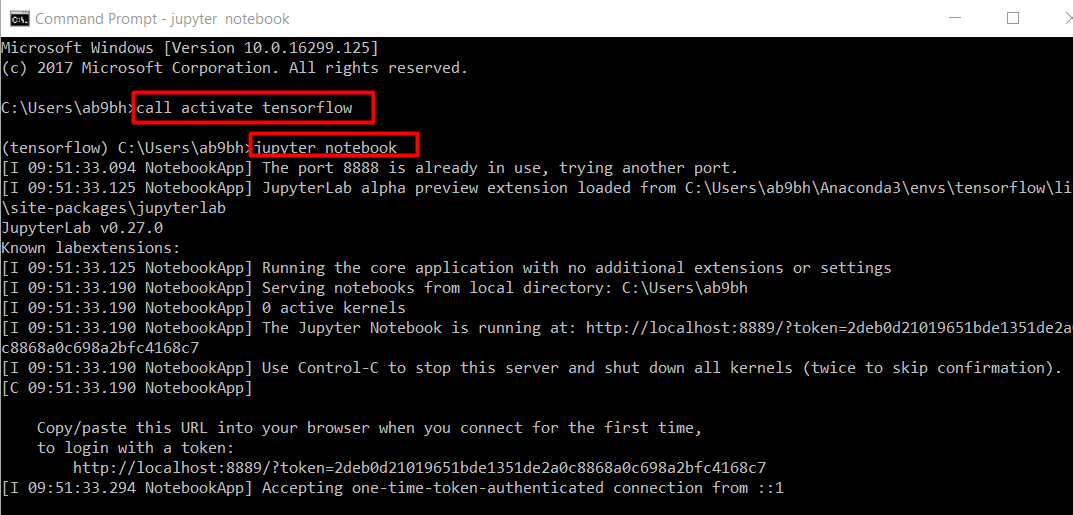
It even allows you to write programming code within the text without losing any syntax. To keep notebooks running smoothly, we need to keep the command prompt or terminal open, even after it has opened homepage. If you close it, notebooks that you are working with, won't be able to communicate with the local server, and hence, any work you do, will not be saved on persistent memory. To check whether the installation is successful or not, and run the Jupyter Notebook, run the following command in the Anaconda prompt or command prompt or terminal (Mac/Linux).
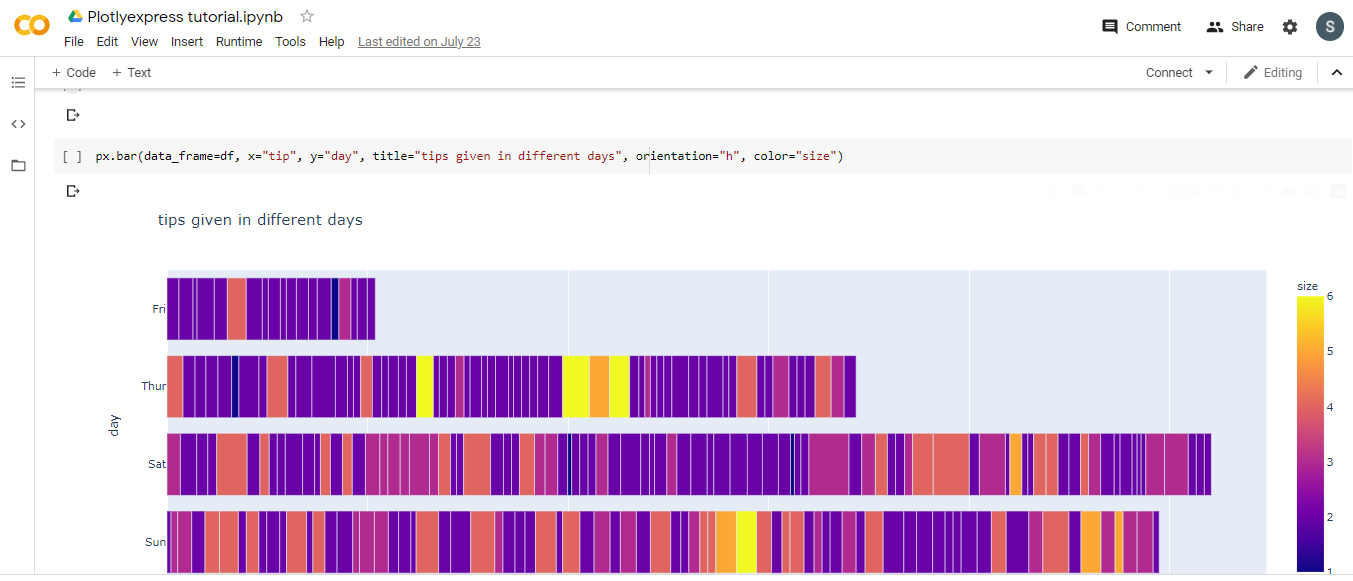
When you install Jupyter Notebook into a virtual environment via the pip install command, you get to run it as an independent package or module in a virtual space. Once you start Jupyter, you're all set to create new notebooks, start a project, and create a coding environment of your choice. You can also install Python using Anaconda, which will provide a rich environment on your notebook with prebuilt packages distributed. Anaconda is available for download on the official Anaconda website – both new and old distributions of Anaconda are available. Then, run jupyter notebook via the Windows Command Prompt. Now, the Jupyter Notebook supports both Python 3 and R programming languages.


